We often think of mindfulness and meditation as a drawn-out, sustained exercise—when in reality, they’re just a collection of micro-moments of stopping, breathing, really noticing our own bodies and our own lives, getting distracted, and then coming back again. Over and over.
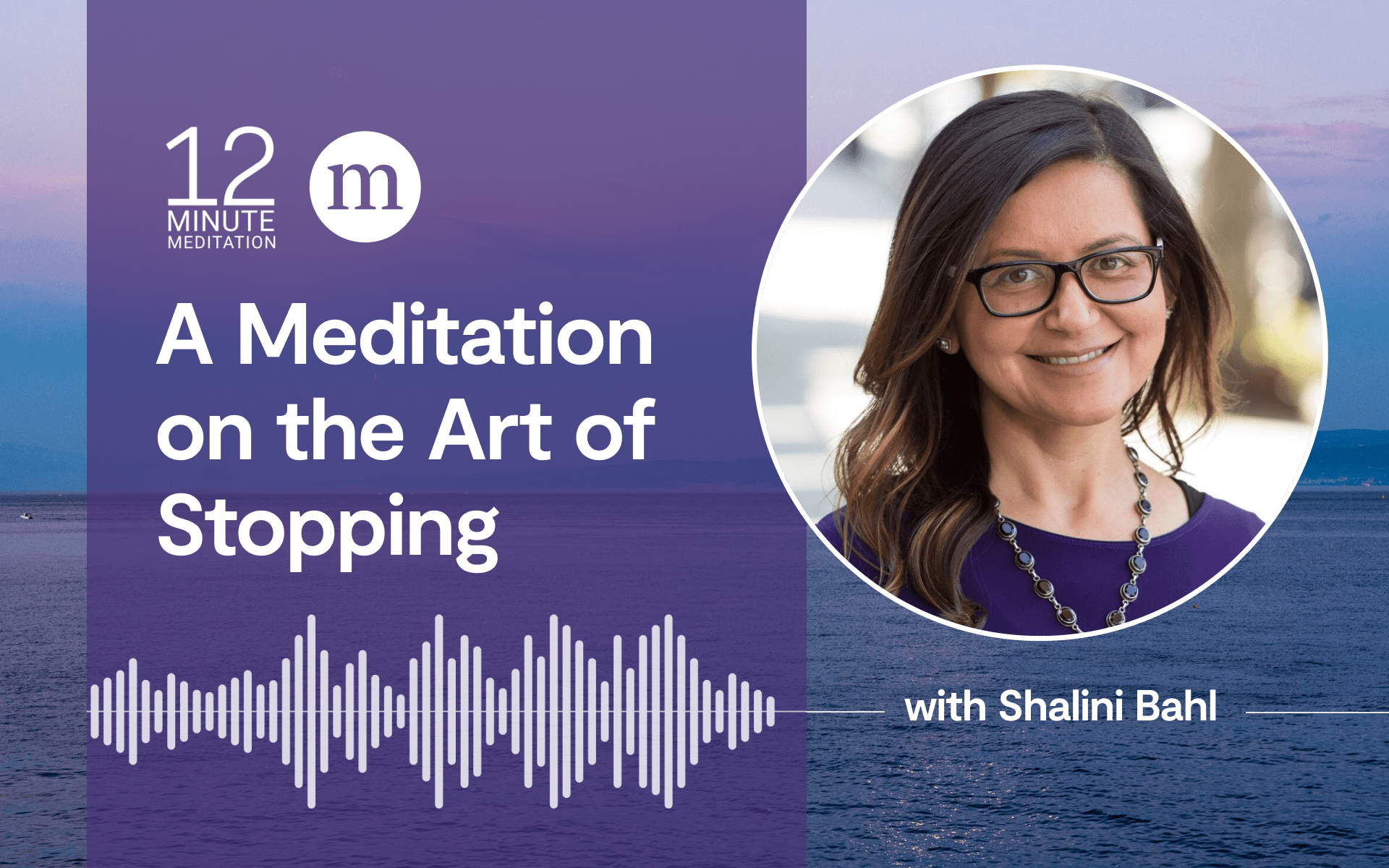
As this week’s teacher Shalini Bahl puts it, today’s guided practice is about the art of stopping: letting go of our regular habits of the mind—the pushing, pulling, running in circles— and instead just being for a moment.
This is an extended practice, but as a bonus, we’re also sharing a micro-practice version below that you can take into busy days.
And don’t miss Shalini’s article on Mindful.org that’s all about the power of micro-practices to affect our daily choices.
A Meditation on the Art of Stopping
Read and practice the guided meditation script below, pausing after each paragraph. Or listen to the audio practice.
- Start by coming to a comfortable posture where you feel supported. If you need more cushions or something to support your back so you feel the elongation along the back of your spine and rolling your shoulders up, back, and down. Rest your hands facing palms up or palms down. When you feel ready, lower or close your eyes.
- Receive the sound of the bells as an invitation to the mind to be fully present. To this body, to this breath. Notice the fact that you’re breathing. There’s no need to change your breath in any way. If it’s shallow, let it be shallow, if it’s deep, let it be deep. Just rest your awareness in this breath, entering your body, following it as far as it wants to go. Notice the slight pause when the in-breath changes to out-breath. Then rest in the awareness of that exhale until the out-breath fully leaves your body. And then the pause, resting in that pause before the breath enters the body.
- Follow this cycle of breathing at your own pace, resting in awareness. You’re not thinking about your breath, you’re really starting to sense the breath, the coolness, the touch of the breath as soon as it enters your nostrils. Feel it move in your body, the expansion, as you breathe in, in your lungs, in your chest, in the belly, wherever you feel it. As you inhale, breathe in and then exhale, really sensing that contraction, the letting go.
- Every time your mind wanders, which it will, just notice that with kindness. Let go of that thought for now, knowing you can always return to the plans, to your thoughts, after the practice. For now, just let go of those thoughts and return back to this awareness of the breath.
- Just for these few moments, let go of any rushing, of any judging, of expectations. Allow yourself to breathe just the way you are, as you are. Give your full care and attention to every inhale. To every exhale. And the spaces in between.
- When you’re ready, find one place in your body where you can really feel the direct sensations of breathing. It could be the touch of the breath in the nostrils or the upper lip region where you feel the coolness of the new breath entering the nose, the tingling in your nostrils, or the warmth as you exhale, touching your upper lip.
- If it feels more natural for you, you can turn your attention to feel your breath in the region of your chest or your belly. Find that one place where you can feel the direct experience of breathing. For the next few minutes, stay there with the direct sensations of breathing. Again, keep it effortless, just a very gentle resting in that awareness of the breath.
- If it feels dull, you can open your eyes a little bit. Make your inhale more conscious. If your mind is really active, give more attention to the exhale, the slowing down of your exhale.
- What we are practicing here is the art of stopping and letting go—letting go of our distractions, of our regular habits of the mind, of pushing, pulling, running in circles. We’re just being here, fully present to your breath, allowing yourself to feel your breath directly.
- Notice your expectations of what’s next, of how things should be, even how this practice should be. Notice how your attachments can get in the way of your experience of inner calm in this moment. Soften the grip of those attachments and just return to your direct experience of the breath. Just this one breath.
- Now, expand your awareness of this breath, of the feeling of this breathing in your whole body. You can stay either focused on that one place or you can expand the awareness of this breath moving through your body. Feel your whole body breathing in, breathing out. Notice those micro-moments of letting go of distractions and staying present.
- Before we end this practice, take a few moments to listen within to what’s present. Just listen, taking a few moments to listen as your mind and body are a little calmer. Maybe there’s clarity of way you can bring in more of this practice of inner calm in your life, whether it’s in your relationships, with yourself, in your work. Just listen within to where this practice of inner calm can be most skillful, most beneficial to you and your loved ones. May we carry forward these qualities of inner and outer calm in all our actions and interactions.