
“I think I’m going to shoot myself,” I screamed in exasperation.
“Why?” asked art teacher Barbara Kaufman in a soft, melodic voice.
“Look at what I’ve done with that blue paint!” I replied, pointing to my sad painting of a Buddha looking like an emaciated Project Runway model. “It’s a disaster!”
I thought I knew something about painting when I signed up for this retreat on creativity and mindfulness at the Spirit Rock meditation center in Northern California. After all, I’d studied traditional figure painting at the Corcoran College of Art and Design and had even spent time in Italy learning from the masters. But none of that seemed to matter now. The brushes were terrible and the paint—a fast-drying, water-based tempera—was so bright and cheerful that everything I did turned into a kindergarten birthday decoration. My painting had started out as a picture of the Buddha on fire but had somehow morphed into a muddy purple-and-gray mess like something by El Greco on happy pills.
“Let’s turn this into a learning experience,” says Barbara, trying to calm me down. “Why did you start to paint over the gray?”
“I thought it was looking too dark,” I replied. “So that’s when the judgment came in. I think there’s some muddiness inside of you. You don’t trust your first instinct. You have to edit it and paint it over and you end up with a muddy picture. You need to go with what’s emerging and listen to what the painting needs.”
How did she know that about me? The reason I’d come to the retreat was to figure out a way to grapple with my inner editor. When I was a young writer, I thought that creativity was a form of alchemy that required falling into a deep, trancelike state that only a select few artists had ever mastered. I was obsessed with the tricks famous writers had used to stimulate the muse. The German poet Friedrich Schiller inhaled the fumes of rotting apples. Gertrude Stein drove around the French countryside looking at cows for inspiration. Victor Hugo wrote his novels buck naked. None of these ploys worked for me, however.
Years later, when my career as a writer was floundering, I turned to meditation. My teacher at the time told me that creativity was about being fully in the present. She said that she used to spend weeks writing and rewriting her talks trying to make them perfect until she realized that all she had to do was trust the moment and let the words flow effortlessly. That insight inspired me to break through some of my more persistent blocks, but part of me still longed to tap into the wild, free-wheeling creativity I sensed was buried inside me. The creativity I knew when I was a child.
That was the world that Barbara (and her colleague Claudia Erzinger) played in. “You don’t have to be in a special state in order to create,” she said. “The creativity will meet you where you are.” It’s all about “deep listening,” she added, and going far beyond “I like/I don’t like” and “I want/I don’t want.” “It’s pushing yourself to your edges and coming face to face with the ideas and attitudes that are limiting you. When that happens, it can be completely transformational.”
• • •
Spirit Rock is a peaceful sanctuary in the golden hills surrounding the San Geronimo Valley, about 25 miles north of San Francisco. As I drove onto the grounds past a large herd of cows and the road sign that read “Yield to the Present,” I noticed a small raft of wild turkeys making their way slowly down the road toward the pasture. The retreat was being held in a large meditation hall overlooking a hill where a red-tailed hawk circled quietly, searching for prey.
The metaphor that Anna Douglas, one of the founding teachers at Spirit Rock, used to describe the retreat was “frozen ice cubes melting.” “Melting is good,” she said. “Melting the frozen judgments, plans, ideas that keep you from being in the moment. And mindfulness is a tool for dealing with the hard things that come up during melting.” Listening to her, I finally understood what my college mentor, poet Edwin Honig, was talking about when he told me that the secret of creativity was “gliding on your own melting.”
The 50 or so participants were divided roughly into equal groups of writers and painters, and the idea was that we would spend a good part of the time practicing our craft when we weren’t meditating or listening to talks. The writing teacher was author Albert Flynn DeSilver, who described his approach as “embodied creativity.” It combined meditation and quick, spontaneous writing exercises that, he said, were designed to “awaken unconscious ideas and emotions that are hidden in our bones.” That sounded interesting, but, given my profession, I worried that it might also rouse my inner critic, so I opted to go with the painters.
To my delight, the retreat also included daily yoga practice. “We’re inviting your whole being to be here,” said Anna. “The point-and-click world we live in often leaves out the body. But this week is about letting go of your mind and dropping down into your body.” Yoga and creativity, added teacher Anne Cushman, both deepen our intimacy with experience. With yoga, she explained, “you discover that whatever part of your experience you pay attention to blossoms under the warmth of your attention. And the same can be said about creativity.”
When Anne, an accomplished novelist and journalist, started writing fiction, she said “the editor part of her mind often shut down the creative part before it even had a chance to open its mouth.” One effective way to break through that block, she learned, was through intense meditation. “There’s a way of meditating where you drop deeper beneath the surface of the ocean. All the big waves of thought are moving on the surface, and you don’t necessarily have to quiet them, but you can learn to scuba dive down and contact this other layer that isn’t so churned up.” Another powerful strategy was practicing yoga in a way that focused on following “the thread of aliveness” in her body rather than trying to strike picture-perfect poses. “Doing yoga that way,” she added, “taught me how to tap into something that was moving through me when I was writing and let it guide the flow of the story.”
• • •
The science bears this out. Being open to experience is the single most consistent personality trait that predicts creative achievement, according to Scott Barry Kaufman, a psychology professor at the University of Pennsylvania and one of the nation’s leading authorities on creativity. But that means being open not only to your observations of the external world, but also your intuition, imagination, and intellectual curiosity.
The other relevant traits exist on a spectrum: extrovert–introvert, agreeable–disagreeable, conscientious–disorganized and narcissistic–emotionally stable. “Creative people are good at surfing those traits,” he said. “Being agreeable? There are times when being a total jerk can help your creativity. Conscientious? Look at Einstein’s desk when he died. It was a huge mess. But being open to experience is the sturdy one, no matter what your creative process.”
That’s why mindfulness is so important.
“We’re often blinded from making interesting connections because we’re so driven by esteem concerns, anxieties, and fears,” he added. “Being mindful is good for calming down the anxieties that get in the way of creativity and attuning ourselves to reality in a deeper way. But there’s a paradox because creativity also includes mind-wandering and fantasizing.”
To be creative, you need to be adept at toggling back and forth between different thinking styles, explained Carolyn Gregoire, the coauthor with Kaufman of Wired to Create. “Creative people learn to be more attuned to their internal monologue,” she said. “That’s how mindfulness and mind-wandering come together: turning inward and paying close attention to what’s going on in your mind, while it’s running off and fantasizing in both positive and negative ways.”
Creativity is a complex process, which involves several interacting cognitive systems. “When we look at the neuroscience of creativity,” said Kaufman, “the system we use a lot in school is the executive attention network, which gives us the ability to focus on the outside world. But that’s not where creativity comes from. It comes from the imagination network, whose functions strike at the core of human existence—our ability to construct an ongoing sense of self, to get in touch with emotions, and to have compassion for others. Those are the things that make us human, not just our ability to be machines and focus on other people’s goals. When it comes to creativity, the executive network and the imagination network usually harmonize very well together.”
• • •
Something shifted in me during the third day of the retreat. After laboring over a misbegotten painting of the exit sign in my dormitory, I suddenly felt the urge to do something sensual and started painting a bare-breasted woman with a long, flowing multicolored skirt. At the end of the day, Barbara stopped by and her eyes lit up. “I leave you alone for a minute,” she said, “and look what happens.”
The next morning after the 6:30 a.m. meditation, I took a walk in the woods and suddenly saw paintings everywhere. The lonely oak beside a meandering trail headed nowhere. The vain blackbird fluttering its wings and shrieking to be noticed. The soft, erotic curves of the sun-flecked hills in the distance. It was exhilarating, as if I were having an enchanting psychedelic vision without drugs.
Then, suddenly, this voice came into my head, saying, “Who are you kidding, Hugh? Why are you wasting your time on such trivia? Shouldn’t you be doing something more practical?”
It sounded like my father the day I told him I was thinking about majoring in art history in college. “No way,” he fumed. “Jesus, Mary, and Joseph. How’re you going to make a living with an art history degree?” As it happened, I majored in English instead, but it creeped me out that somehow I had internalized his narrow-minded view of art.
Later that day, in a Q & A session with the teachers, I asked what I should do with this attack of guilt. Albert speculated that the guilt was connected to my feeling of exhilaration. “On some level,” he said, “you probably don’t feel as if you deserve to be so exhilarated.” Meanwhile, Anna suggested that I have a conversation with my father, which could be tricky since he died years ago. “Give the guilt back to him,” she said. “Tell him you don’t need it anymore.” Both of their comments made emotional sense.
When I returned to the art studio, Barbara asked what I was going to do next with my painting, and I mumbled something about adding a simple beach scene in the background. “I guess you could do that,” she replied, disappointed. “But what would be the dangerous thing to do?”
“I could put a man in the picture,” I answered. “Doing what?” “Whispering in her ear? Reaching out and touching her breast?”
“That’s it.” I couldn’t believe what I was hearing. Barbara was daring me to go somewhere I’d never ventured before.
• • •
None of this surprised Ellen Langer, a psychology professor at Harvard who’s often referred to as the “mother of mindfulness” because of her seminal research on the subject. “When we think of creativity,” she said, “we tend to think only of the final product, but mindfulness is all about the process.” And her research showed that the more mindful the process the better the final product.
The main roadblock to creativity, according to Langer, is our relentless self-evaluation. “People know that they don’t know [the answer], but what they don’t know is that nobody knows,” she added. “If we knew that nobody knows, we’d be confident in our uncertainty. That’s how artists and anyone else involved in a creative endeavor have to act. If you know where you’re going, then you live your life painting by the numbers. But it’s hard not knowing when you think you’re going to be judged negatively. So people pretend and withdraw.”
In one study, Langer and her team made an interesting discovery when they asked people to draw a picture of an animal, then forced them to make mistakes. Of the three groups they studied, one was encouraged to incorporate the mistake into their work and keep going, another was told to forgive themselves for the mistake, and the third was allowed to complete their drawings uninterrupted. Afterward, the first group not only reported enjoying the activity more than the others, but judges also rated their work superior. Why? Because, Langer concluded, incorporating mistakes made the process more mindful. “The fear of making mistakes keeps people sealed in unlived lives,” she said, and removing that fear can be “enormously freeing.”
In her book, On Becoming an Artist, Langer chronicled her journey teaching herself to paint and eventually showing her work in galleries. In the process, she learned that “to be a true artist is to be mindful” and that work executed mindlessly, even if it’s done by skilled artists, will usually feel “in some sense dead.” The key is authenticity. “When we are not pretending or are not mindless in other ways,” she wrote, “the products of our labors will have our own signatures.”
Early on, Langer showed one of her paintings to an art collector friend who told her, “You know, Ellen, there’s something there, but don’t go thinking you’re Rembrandt.” Langer didn’t respond at the time, but she recalled saying to herself, “ ‘And Rembrandt isn’t me.’ Meaning that if I’m true to myself, no one can do Ellen Langer better than me. And I’d rather be a number one Ellen Langer than a number 500,000 Rembrandt.”
• • •
“What now?” asked Barbara, studying my rendering of a bearded young man canoodling with the woman in the striped dress.
“Perhaps a picnic scene,” I said.
“Isn’t there something more dynamic you could do?”
I drew a blank.
“C’mon, there must be something you can think of…”
“Well, I could paint an orgy,” I said half-jokingly.
She smiled and flashed that mischievous look of hers.
As the picture blossomed with men and women frolicking together, my brushstrokes became more and more primitive. I no longer felt as if I were controlling the painting; the painting was painting me.
Then something startling happened. As soon as I added another naked body to the picture, everything changed. Not just in the painting, but inside of me as well. I suddenly felt unfettered and alive, and the images just started to flow. As the picture blossomed with men and women frolicking together, my brushstrokes became more and more primitive. I no longer felt as if I were controlling the painting; the painting was painting me.
Ever since I’d started studying art, I’d longed to paint groups of people relating to each other. But mostly I’d worked with single models because I didn’t have the guts to try anything else. Now—caution be damned—I realized I could do anything I wanted to, without worrying about making it perfect.
That wasn’t the only lesson Barbara had to teach me. Later that day, I told her I was thinking of leaving some of the figures in the painting unfinished, and she bristled at the idea.
“You’re still thinking visually, about making a pretty picture,” she said emphatically. “This painting is about relationships. And these people can’t relate to each other if they’re half-finished.” To her, the figures were living beings, not just lines on a piece of paper. “Don’t jump ahead of yourself,” she added. “Paint those figures and then see what they want you to do.”
That night I was bursting with energy. I woke up at three in the morning and started madly drawing sketches to add to the painting. When I finally got to the studio, I was pleased with what I saw. The painting was like nothing I’d ever done before. It was whimsical, almost child-like, the kind of painting I normally hated. But I loved its raw energy and innocent charm. As a final touch, I added a large-breasted, Mother Earth figure floating angelically above the whole scene. I had no idea where she came from, but she made me smile.
Barbara was excited, too, but she was even more interested in my early-morning drawing spree. “Isn’t it great that all those things are moving inside of you?” she said. “Wouldn’t it be wonderful if that could happen every moment of every day?”
I wasn’t the only one in the room who’d had a breakthrough. As I looked around the studio later that night, I was overwhelmed by how powerful the paintings were. I expected to see lots of landscapes and flower pictures. Instead the walls were filled with heart-wrenching paintings of grief, sorrow, and dark yearnings. “Who would have guessed?” I wrote in my notebook. “So much pain and suffering hidden inside such nice mindful people.”
One of those painters was Elizabeth Bessette, a former yoga teacher and body worker from Brooksville, Maine. “It was scary and hard,” she said, looking back on the process she went through. “But when I completed a painting, I’d look at it and learn something about myself. It was like my unconscious was speaking. One thing I became aware of was about how much I was trying to protect myself from life’s pain. I also realized the pain I felt being separated from life. The paintings made both of those concepts become very alive for me.”
Her most striking painting was a self-portrait of her being strangled by a large green snake. “The paintings I made were bizarre, but they spoke to me,” she added. “I didn’t start out with a pre-conceived idea of what I was going to paint. I just trusted the brush on the paper and let it lead me.”
At one point, she felt shaky and nauseous because she had no idea where she was headed. “We put so much value on a painting, that it’s going to reflect who we are,” she said. “To let go of all the things you know how to do that are kind of clever and artistic and just let the brush lead you—that was a fascinating new concept for me. I didn’t know that’s what I wanted to learn. But in hindsight that was exactly what I was looking for.”
• • •
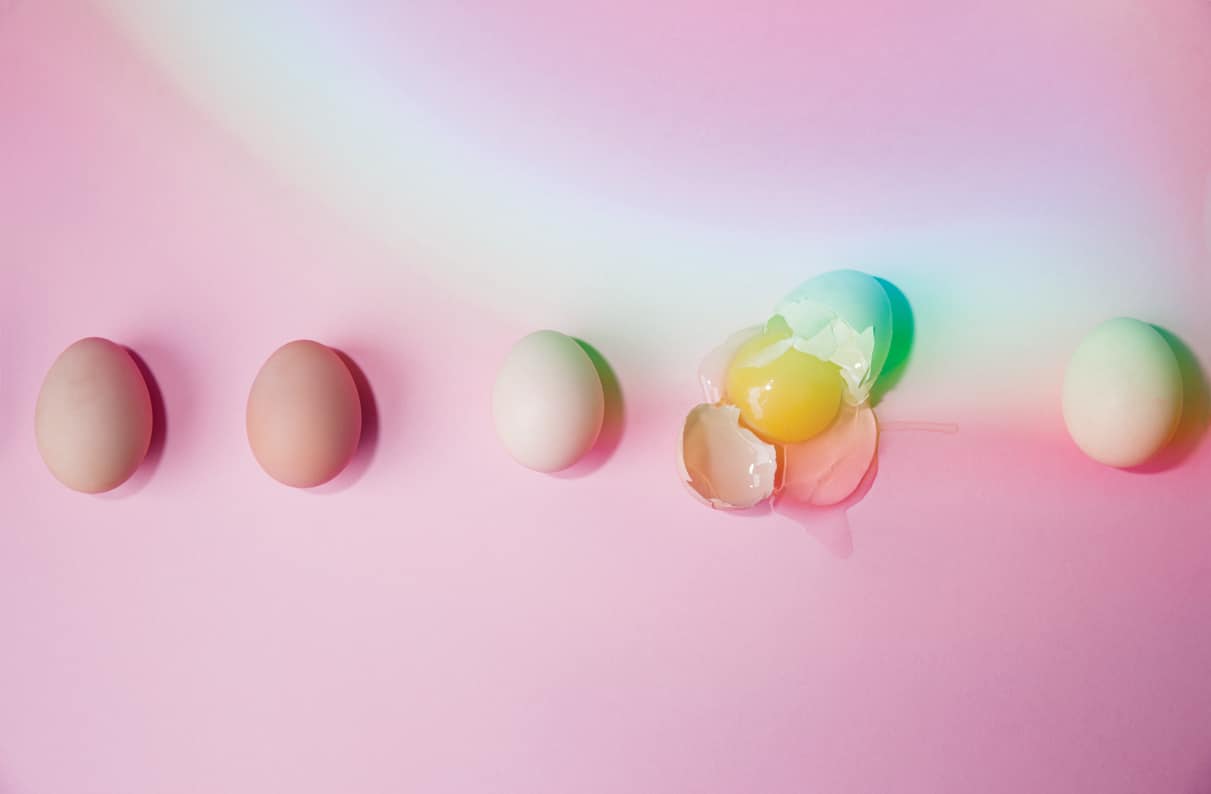
A few weeks after the retreat, I visited Barbara in her painting studio in San Francisco. It was a playful environment with festive hand-painted prayer flags hanging in the windows, walls splattered with bright colors, Jackson Pollock–style, and at one end of the room a large unfinished mural depicting the Crack in the Cosmic Egg.
A gracious, strong-minded artist with warm eyes and curly gray hair, Barbara got into painting in her late 20s because, she said, she felt “this pressure inside that if I didn’t deal with I was going to burst.” In her very first class with Michele Cassou, the pioneering teacher of spontaneous painting, Barbara realized that there was something in her that wanted to come out. “It was waking me up to parts of myself that felt not included,” she recalled. “Strong feelings that I thought were too intense for the world, but they were living in me. I judged the process, I cried, I hated it, I screamed, but it was happening. And it had a voice that told me I could paint big paintings. And big monsters. I could explore God.”
Sometimes all it took was trying a new color. “The first time I painted the color black I had all these ideas of what it would say about me,” she said. “But in the actual painting of it, my whole being came alive. It was forbidden. It was exciting. In the forbidden is a lot of stored energy. And to paint it from an innocent space brings this excitement and curiosity. That’s what’s transformative: when you wake up to the wonder that children have naturally.”
When I started this journey, I thought I was searching for a magical bag of tricks to help me turn dross into creative gold. But what I discovered was that creativity isn’t a fancy parlor game; it’s a more intimate way of relating to the world.
That’s what was happening to me. Once I became conscious of the forces that were squelching my creativity—my guilt, my repressed sexual energy, my rigid view of what constituted beautiful art—a deeper, more complex sense of beauty began to emerge. And my life began to open up in surprising ways, as well. All of a sudden, I found myself saying, “Who gives a fuck?” a lot, especially when one of my fears arose and threatened to box me in a corner. It didn’t happen every time. I am still very much a work in progress. But at least the movement had begun.
“I don’t think most people are aware of how small they live,” said Barbara. “We’re so used to enduring and just getting by. When you ask people, on a scale of zero to ten, how’s your energy, and a lot of times they’ll say, ‘Five, but I’m okay with that.’ What’s stopping us from going for an eight, nine, or 10?”
One day when Barbara was taking a break from painting, she ran into a homeless man in her neighborhood who gave her a remarkable gift. “I used to think that painting was going to make me superhuman,” she recalled. “But in that moment when our eyes met, I realized that he and I were just the same. The painting was actually bringing out my humanity and allowing me to really see him. This was a huge shift in how I saw painting. It wasn’t about being better than others or moving beyond anger. It was about being attuned to the way my being was responding and entering more into life.”
For me, this was the ultimate takeaway. When I started this journey, I thought I was searching for a magical bag of tricks to help me turn dross into creative gold. But what I discovered was that creativity isn’t a fancy parlor game; it’s a more intimate way of relating to the world.
“Everything leads us back to ourselves,” said Barbara. “Sometimes we have to go too far to see that. But what we usually do is play it too safe and close up. Once you start opening, you get a sense that you can stretch more, and then you begin to realize the potential that’s available to you at any given moment. The invitation of creativity is to move beyond the boundaries we’ve set for ourselves. To allow life to permeate those thick walls that we think are so secure.”

Research: The Genius Formula
Dean Simonton, a professor in psychology at the University of California, Davis, tells us what, according to his research, makes a creative genius.
Hugh Delehanty: What separates creative geniuses from the rest of us?
Dean Simonton: Probably the two main factors are (a) tremendous openness to experience and (b) unusual motivational persistence. Of course, they have to be highly intelligent and well-versed in their particular domain, but not necessarily more so than their far less creative colleagues.
Creativity always demands the willingness to take risks, so you have to accept the possibility of failure. Creativity also requires openness—curiosity, broad interests, and tolerance of ambiguity and novelty. Big-C creators just show these qualities to a higher degree, and apply them to a domain in which they have acquired sufficient expertise.
—Dean Simonton, professor in psychology at the University of California, Davis
HD: You’ve talked about creativity as not being just an individual phenomenon. Why is the creator’s social context so important?
DS: First, the social environment provides the context in which creative development takes place. If Isaac Newton were born in the middle of the Dark Ages, he couldn’t have participated in the Scientific Revolution. At best, he might have become a very erudite monk. Second, the social environment provides the setting in which ideas are accepted or rejected—and that acceptance or rejection then determines whether or not those ideas are even deemed creative. A “neglected” genius who remains so will not count as creative.
HD: How are scientific geniuses different from artistic geniuses?
DS: They are similar in that they both use some version of a generic process to obtain their creative ideas. For example, trial and error is used in both art and science. The difference is that scientists must operate under stronger constraints than do artists. For instance, science fiction can be great art, but science fiction will not be great science, particularly if the fiction violates one or more laws of physics. The Death Star is impossible in science, but not in art.
HD: Why is true genius so rare?
DS: Many different genetic and environmental factors have to come together in a single person before a genius can emerge. Thus, someone might have all that it takes from a genetic standpoint—such as intelligence, openness, and motivation—but be born at the wrong place and wrong time. Like the example I gave above with respect to Newton. Or the times may be ripe for a genius to appear, but a particular combination of genetic components are necessary, and nobody has them at that time.
HD: What can “small-c” creators learn from your discoveries?
DS: Creativity always demands the willingness to take risks, so you have to accept the possibility of failure. Creativity also requires openness—curiosity, broad interests, and tolerance of ambiguity and novelty. Big-C creators just show these qualities to a higher degree, and apply them to a domain in which they have acquired sufficient expertise.
More on Mindfulness and Creativity:
- Does Meditation Boost Creativity? Research shows that some key elements of meditation stimulate creativity, and others may not.
- 5 Rituals of Highly Creative People: Five successful artists demystify the creative process.
About The Author

About The Author