

Jane Fonda did not come to Spirit Rock to offer comfort.
She came to invite attention toward what we’re inheriting, what we’re losing, and what we still have to protect.
For different generations, Jane Fonda has arrived in various forms. Some of us know her as an Oscar-winning actress whose early roles challenged cultural norms in films like Klute and Coming Home; others might remember her from her iconic fitness workouts in the early 80s (if you know, you know.)
But Jane Fonda doesn’t just redefine herself decade after decade, she reframes and rebuilds the very structures and movements she’s a part of. Whether that’s turning fitness into accessible self-care for women, relaunching the Committee for the First Amendment (free speech, anyone?), taking on the climate crisis by starting the Jane Fonda Climate PAC, or redefining vitality for anyone later in life through her role on the beloved show Grace and Frankie. These chapters, however, only hint at a deeper through-line.
Jane Fonda models a form of mindful leadership rooted not in legacy, but in invitation, showing how presence, curiosity, and connection can awaken action in every generation.
For decades, Fonda has leveraged her visibility as a platform, founding media outlets, funding grassroots organizing, lending her body to protests, and repeatedly engaging in uncomfortable conversations in service of collective change. Today, she directs that same attention toward the climate crisis, whether by forging relationships with younger artists like Maggie Rogers, who went on to more openly use her platform for climate and social advocacy after connecting with Fonda, or by studying with Roshi Joan Halifax to deepen her meditation practice and the way she shows up in the world.
One thing is for sure: Jane Fonda models a form of mindful leadership rooted not in legacy, but in invitation, showing how presence, curiosity, and connection can awaken action in every generation.
Mindfulness As Training, Not Escape
Fonda recently spoke as part of Spirit Rock’s EcoDharma & Transformational Culture Program (ETCP), a three-year initiative launched in January 2025 that explores how mindfulness and contemplative practices can support more intentional responses to climate change. While this program draws on Buddhist teachings, it is intentionally inclusive, inviting participants from diverse faiths and backgrounds.
In ETCP’s context, “spiritual” refers to practices that help cultivate awareness, compassion, and resilience—tools for understanding and responding to climate-related stress. The program addresses the intersection of mindfulness, ecological issues, and the urgent need for thoughtful, effective action.
For many readers of Mindful, meditation may feel like refuge, a place to step away from the unrelenting churn of news cycles, politics, and ecological grief. What this gathering at Spirit Rock made clear is that mindfulness was never meant to be an escape hatch. It was meant to be training.
At a moment when the climate crisis feels simultaneously overwhelming and dangerously normalized, Fonda’s presence at Spirit Rock Meditation Center landed with the weight of lived experience—decades of activism, moral reckoning, and an unshakeable belief that we cannot separate inner work from outer action. Her conversation with climate journalist Greg Dalton functioned as a deeply reflective inquiry into what it means to stay awake, empathetic, and engaged as time runs out.
For many readers of Mindful, meditation may feel like refuge, a place to step away from the unrelenting churn of news cycles, politics, and ecological grief. What this gathering at Spirit Rock made clear is that mindfulness was never meant to be an escape hatch. It was meant to be training.
Urgent & Hopeful
Fonda spoke with respect to urgency, but not from a place of hopelessness. Instead, she framed this moment as one that demands both honesty and courage. “This is a moment when we have to bring our empathy to the fore,” she said, speaking to the deep divisions defining public life. Empathy, for her, is not a passive feeling—it is an active discipline, one she traces directly to her life in the arts.
“Acting is a profession of empathy,” Fonda explained. “We have to enter the skin of another human being and understand them … You can’t do that without empathy. And you have to have empathy even for somebody that you don’t like.”
That capacity, to stay open rather than armored, has helped to shape her activism as much as her performances. Fonda spoke candidly about how long it took her to soften what she called an “armored heart,” and how belonging to movements, rather than acting alone, made vulnerability possible. “There can come a moment in life when you enter a situation and, you know, this is where I’m supposed to be,” she said. “If you’re not alone, if you’re part of a movement, that sense allows you to become vulnerable and to open your heart.”
This insistence on collective action, grounded in relationship rather than righteousness, ran through the entire conversation.
ETCP’s mission is twofold: to support interfaith leaders and activists in meeting climate trauma with resilience and joy, and to empower a new generation of global citizens.
Over the next three years, ETCP will offer online lectures, class series, in-person retreats, and training programs designed to support communities engaging with climate change not only as a scientific or political issue, but also as a profoundly emotional and spiritual one. The program is guided by a core planning team of respected teachers and leaders, including Ayya Santacitta, Bonnie Duran, Carol Cano, James Baraz, Kirsten Rudestam, Kristin Barker, Mark Coleman, and Yong Oh, in collaboration with partners such as One Earth Sangha, Braided Wisdom, Aloka Earth Room, and Awake in the Wild.
Its mission is twofold: to support interfaith leaders and activists in meeting climate trauma with resilience and joy, and to empower a new generation of global citizens. At its heart is a radical proposition—that joy, mindfulness, and love for the Earth are not distractions from climate action, though essential to sustaining it.
When Mindfulness Meets the Climate Crisis
For many meditators, the connection between mindfulness and climate change is not apparent. Sitting quietly with the breath can feel worlds away from melting ice caps, polluted water systems, or data centers sprawling across the landscape.
Fonda expressed concern about AI and the rapid speed of technological advancement. “I’m horrified by it,” she admitted, acknowledging her own complicated relationship with technology. “I have ChatGPT on my phone. I feel guilty… I don’t understand it well enough to know how to combat it.”
Rather than offering easy answers, Fonda modeled something rarer: the willingness to stay with not-knowing without disengaging. Climate action, she suggested, does not begin with mastery; it starts with attention.
Her reflections on Indigenous knowledge underscored what has been lost through disconnection. Recalling time spent learning about the Ecuadorian rainforest, she talked about communities that live in conjunction with the land. “They showed us which plants heal which diseases,” she said. “We once knew how to listen to plants. We’ve forgotten how.”
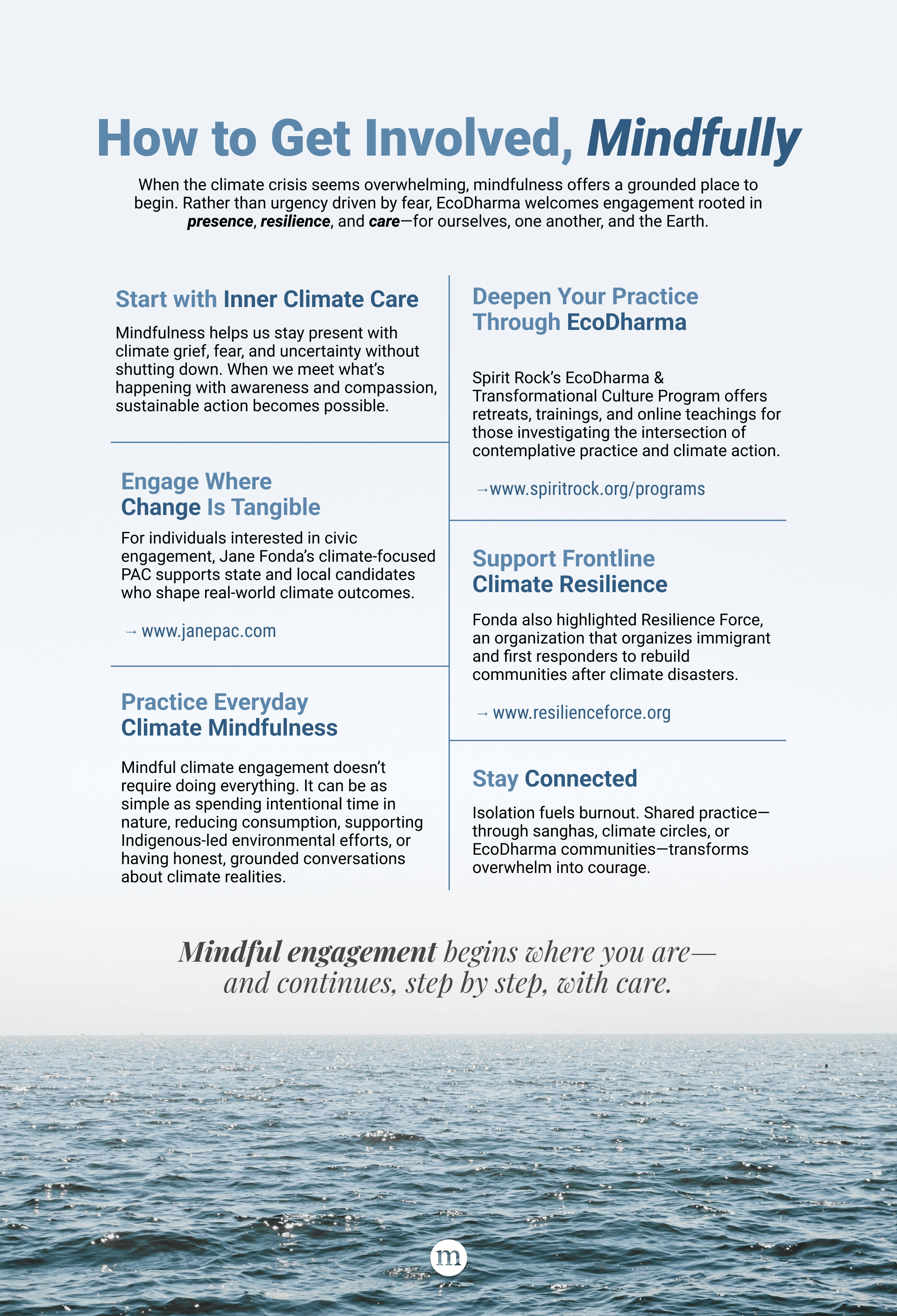
Mindful engagement does not mean doing everything. It means doing something with intention, alongside others.
EcoDharma, as Spirit Rock frames it, is precisely this remembering—not as nostalgia, but as practice. And the key part of practice, when we hold both the Dharma and the environment front and center in our minds, is to understand that we all have something to do, no matter how small the task or step may be. As ETCP leaders emphasize, mindful engagement does not mean doing everything. It means doing something with intention, alongside others.
Identifying Our Unique Role to Play
A recurring question throughout the retreat was one many people quietly carry: What can I do?
Fonda’s answer was pragmatic and unsentimental. After years of protest through Fire Drill Fridays, she and a small group of collaborators recognized a gap between public pressure and policy change. “We haven’t got the legislation that’s commensurate with what science is saying we have to have,” she said. “The reason is that so many elected officials take money from the fossil fuel and petrochemical industries.”
That realization led to the creation of Jane Fonda Climate Pac, a political action committee focused on down-ballot races and state and local positions that often receive little attention but wield enormous influence over climate outcomes. “Public utilities, school boards, city councils, state legislatures, attorneys general,” Fonda noted. “All these people have huge power.”
The results have been striking: hundreds of climate champions elected, many of them women and women of color, willing to stand up publicly for environmental rights. “It’s working,” she said.
Alternate Entry Points to Climate Action
For those wary of politics, Spirit Rock’s EcoDharma program offers additional entry points and ways to engage, with an emphasis on joy-based action, interconnection, and resilience. This programming is designed precisely for people who feel overwhelmed, polarized, or exhausted by climate discourse.
Perhaps the most resonant moment of listening to Fonda speak was when she was asked about courage—how she continues to speak so openly, without becoming defensive, after decades in the public eye.
“It has been a process,” she said. “It took me a long, long time to open my heart.” What changed was not confidence, but belonging. “Being part of a movement… allows you to become vulnerable.”
She spoke about care—sleep, community, working with people she admires—as essential, not indulgent. “I’m a late bloomer,” she said with a smile. “But being a late bloomer is okay as long as you don’t miss the flower show. And I’m in the midst of a flower show.”
EcoDharma does not ask practitioners to abandon stillness. It asks them to let stillness inform their response. To allow mindfulness to widen into care, and care into action.
In that image, flowers blooming against the odds was a quiet invitation. EcoDharma does not ask practitioners to abandon stillness. It asks them to let stillness inform their response. To allow mindfulness to widen into care, and care into action.
As Fonda reminded the room, hope is not something we wait for.
It is something we practice—together.
For more ways to connect, here’s a mindful action guide to use & share. Links are also provided below.